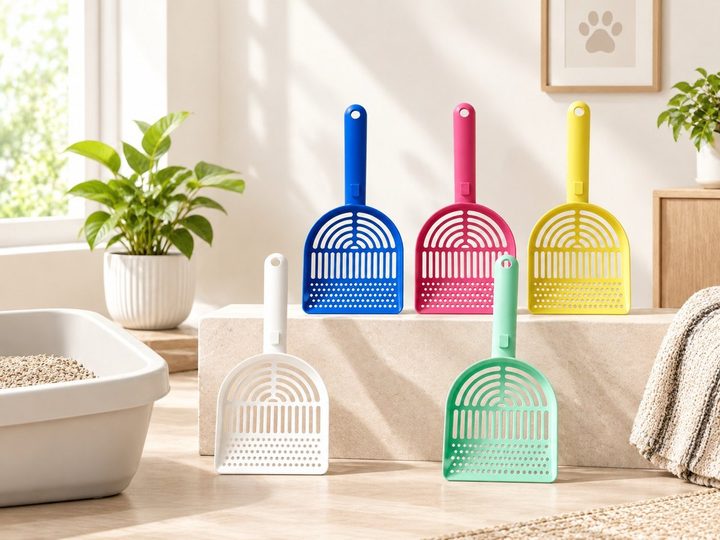

Pet retail is built on small accessories. A litter scoop or a grooming brush will never carry the margin of a plush cat bed, but it carries the volume, the shelf presence, and the repeat order — which is why importers usually source them alongside their main lines rather than as an afterthought.
Why the small items decide the reorder rate
- A customer who replaces a worn scoop every few months is a repeat customer; one who buys a scoop that breaks in a month is a refund.
- Small accessories cost little to ship and fill space in a container that a bulky order leaves empty.
- They are also the easiest place to add a private-label line, because tooling and artwork costs are low.
- The failure modes are practical, not technical — cheap hinges, thin handles, warping, rust.
Litter scoops: the details that cause returns
- Depth and angle of the scoop head — a shallow head drops litter between the tines and the pan, which owners notice immediately.
- Tine spacing and slot width — confirm the spacing suits the litter type common in your market, since fine and coarse litters behave differently.
- Handle length and grip — check the joint between handle and head under load; this is the first thing to fail.
- Rigidity of the material — a scoop that flexes under a full load feels cheap even if it never breaks.
- Warping in shipment — stacked scoops deform in a hot container. Ask how they are packed, not just how they are moulded.
Grooming tools: test the working surfaces
- Pull on the bristles and pins — anchoring is where budget tools fail first, and a brush that sheds bristles ends the relationship.
- Pin tips must be rounded and smooth; sharp tips are a safety complaint waiting to happen.
- Rust resistance matters more than finish in humid markets — ask what the metal parts are plated with.
- Grip comfort with wet hands, since grooming usually happens near water.
- If the tool has a loop or strap, check its attachment point, not just the loop itself.
Packing and private label for small accessories
Small accessories sell best when they are visible. Hanging cards usually outperform plain poly bags in retail, so confirm the format your channel uses — Euro slot or peg — before artwork is finalised, and leave space for a barcode and local-language text. At bulk level, agree the master-carton count and how the units are protected at the corners, because loose-packed scoops and brushes arrive scuffed and stop selling. If you are building a private-label range, ask for a pattern or colour sheet and confirm costs per variant rather than per unit, since small items are usually priced in ranges.
Briefing a supplier on a small-accessory order
- Target retail price and the price you can pay per unit at your likely volume.
- Product dimensions, and the size or colour range you want to offer.
- Packaging format, with the hanging format and artwork dimensions.
- Market and channel, since that shapes labelling and language.
- Which documents you need for your market, requested for the exact material and the exact factory.
- Your required MOQ and delivery window, so samples and tooling can be planned against them.
Send us your target sizes, price band, and market, and we will come back with material and packing options for a sample run — including how the units stack in a master carton.